Strategic Roadmap
Executive Summary
Strategic Vision
Position as a market leader in AI productivity tools by leveraging the explosive 15.9% CAGR growth trajectory, capitalizing on the shift from on-premise to cloud deployments, and establishing dominance in virtual assistants and data analytics segments while expanding into high-growth verticals and geographies.
Strategic Objectives
Strategic Timeline Visualization
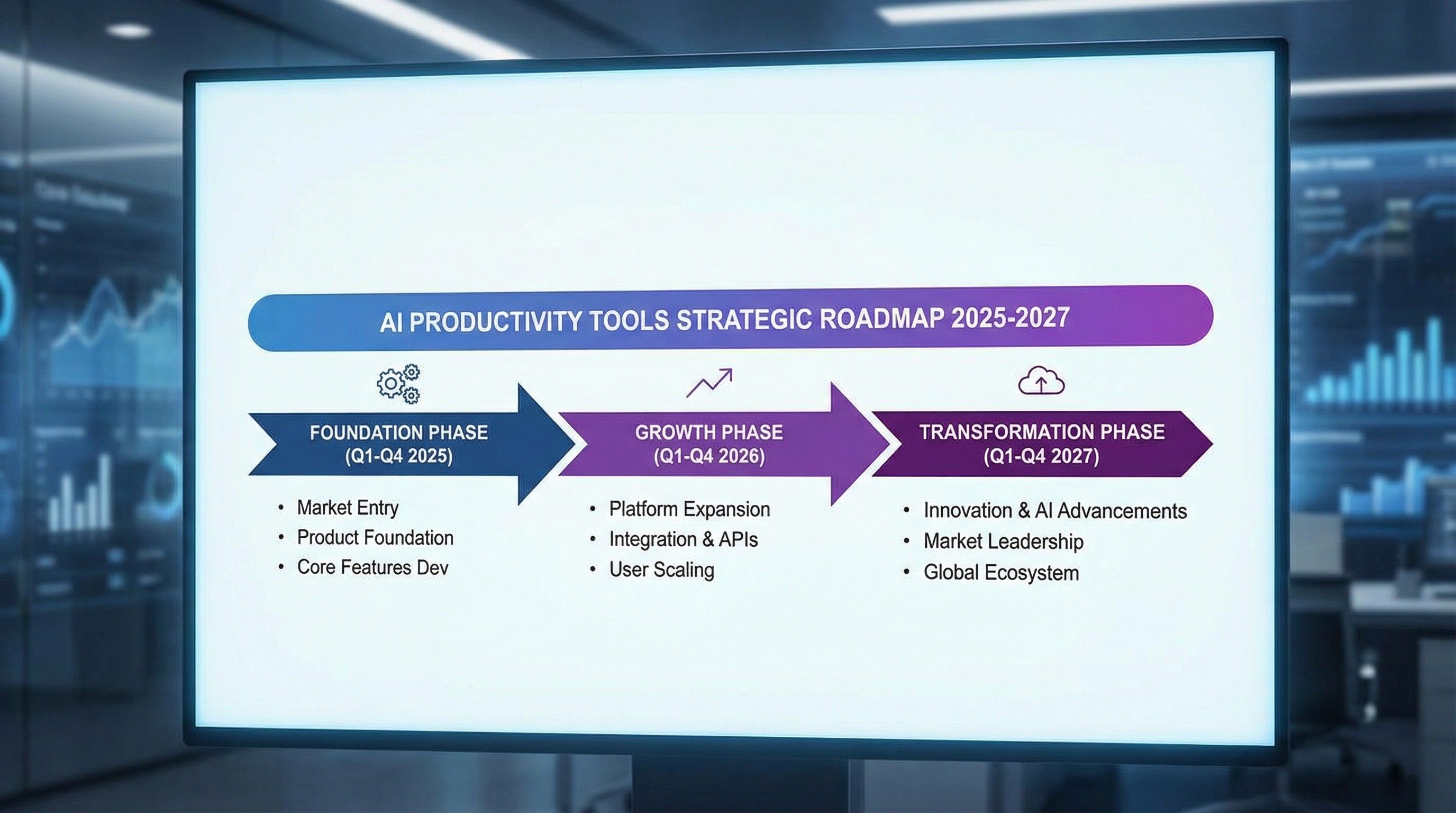
Strategic Timeline: 2025-2027
- Launch MVP virtual assistant with advanced NLP capabilities
- Establish cloud infrastructure foundation on major platforms
- Secure initial enterprise partnerships in BFSI sector
- Build core data analytics engine with predictive capabilities
- Establish North America market presence and sales channels
- Implement security and compliance frameworks for enterprise adoption
- Recruit foundational AI/ML talent and engineering teams
- Achieve product-market fit with 100+ enterprise customers
- Scale cloud infrastructure to support 10,000+ concurrent users
- Launch integration marketplace with 20+ key business tools
- Expand to IT/Telecom vertical with sector-specific features
- Establish strategic partnerships with Microsoft/Google ecosystems
- Achieve SOC 2 Type II and ISO 27001 certifications
- Build customer success organization for enterprise support
- Launch multi-agent AI ecosystem with interoperability framework
- Expand to Asia Pacific markets with localized offerings
- Introduce advanced data analytics with real-time insights
- Scale to 500+ enterprise customers across 3 continents
- Launch Healthcare vertical solution with compliance features
- Establish technology partnerships with ServiceNow and Deloitte
- Achieve 99.99% uptime SLA with global infrastructure
- Capture 8-10% market share in target segments
- Launch generative AI capabilities across platform
- Expand integration marketplace to 100+ applications
- Enter Retail & E-commerce vertical with specialized tools
- Establish European market presence with GDPR compliance
- Build developer platform with APIs and SDKs
- Scale to 1,000+ enterprise customers globally
- Launch industry-leading autonomous AI agents
- Achieve market leadership position in virtual assistants
- Expand to 10+ verticals with specialized AI solutions
- Establish innovation labs in North America, APAC, and Europe
- Launch enterprise AI marketplace with 3rd-party solutions
- Achieve 2,000+ enterprise customers with 95%+ retention
- Secure strategic investments for global expansion
- Capture 12-15% overall market share across segments
- Establish platform as de facto standard for enterprise AI
- Launch M&A strategy to acquire complementary technologies
- Expand to emerging markets in Latin America and Middle East
- Build thriving developer ecosystem with 10,000+ active developers
- Achieve profitability with sustainable growth trajectory
- Position for potential IPO or strategic acquisition
Strategic Themes Matrix
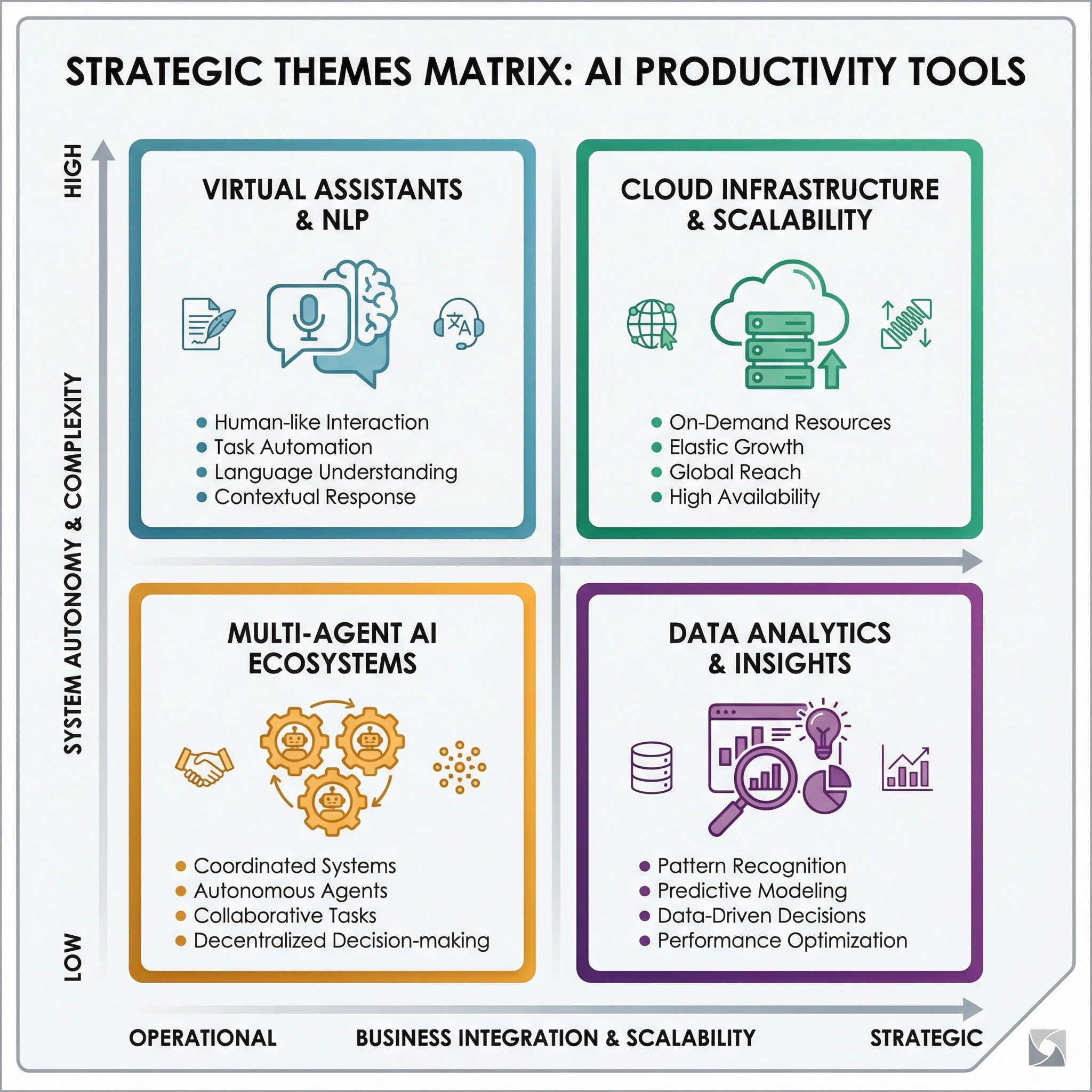
Strategic Themes & Major Initiatives
Virtual assistants represent the largest market segment at 25.4% share in 2024. This theme focuses on establishing market leadership through advanced natural language processing, conversational AI, and multi-modal interaction capabilities that set new industry standards.
Strategic Initiatives Across Phases
Success Metrics
While on-premise deployment currently holds 60.7% market share, cloud is the fastest-growing deployment model. This theme positions us to lead the inevitable industry shift to cloud-native architectures with superior scalability, security, and integration capabilities.
Strategic Initiatives Across Phases
Success Metrics
Emerging trend with high enterprise demand. Multi-agent systems represent the future of AI productivity, enabling complex workflows, autonomous decision-making, and seamless collaboration between specialized AI agents across business functions.
Strategic Initiatives Across Phases
Success Metrics
Data analytics is the fastest-growing offering segment, driven by enterprise demand for AI-powered business intelligence, predictive analytics, and real-time insights that drive data-driven decision-making across organizations.
Strategic Initiatives Across Phases
Success Metrics
Market Expansion Strategy Map
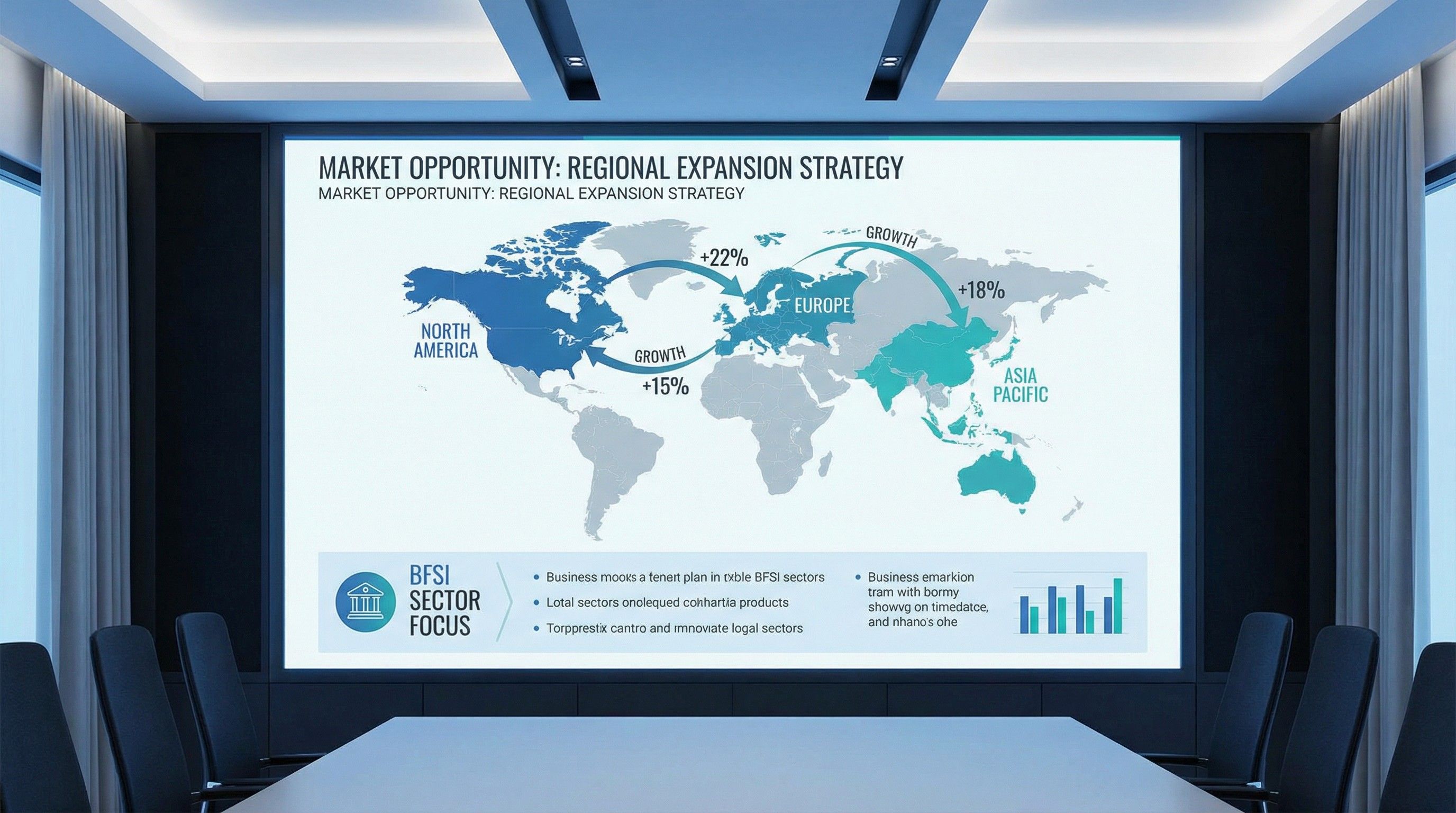
Market Expansion Strategy
Geographic Priorities
Vertical Market Focus
Strategy: Deploy AI-powered fraud detection, risk management, customer service automation, and regulatory compliance solutions. Target tier-1 banks and insurance companies with enterprise-grade security.
- Automated KYC/AML compliance
- AI-driven trading analytics
- Customer service chatbots
- Risk assessment automation
Strategy: Leverage existing strength with advanced DevOps automation, network optimization, customer experience management, and IT service desk solutions.
- Intelligent network monitoring
- Automated incident resolution
- Customer churn prediction
- Infrastructure optimization
Strategy: Develop HIPAA-compliant solutions for clinical decision support, patient engagement, administrative automation, and medical research acceleration.
- Clinical documentation AI
- Patient scheduling optimization
- Medical imaging analysis
- Drug discovery support
Strategy: Capture growing demand with personalized shopping experiences, inventory optimization, dynamic pricing, and customer service automation.
- Personalization engines
- Demand forecasting
- Supply chain optimization
- Virtual shopping assistants
Competitive Positioning & Partnerships
- Multi-Agent Excellence: Industry-leading orchestration platform for autonomous AI agents
- Cloud-Native Architecture: Superior scalability and performance vs. legacy on-premise solutions
- Vertical Specialization: Deep domain expertise in BFSI, Healthcare, and IT sectors
- Enterprise-Grade Security: Zero-trust architecture with SOC 2, ISO 27001, HIPAA compliance
- Developer Ecosystem: Open platform with robust APIs, SDKs, and marketplace
- AI Innovation: Continuous R&D investment in generative AI and advanced NLP
- Cloud Platforms: Strategic alliances with Google Cloud, Microsoft Azure, AWS for co-selling and technology integration
- Enterprise Software: Deep integrations with ServiceNow, Salesforce, SAP for workflow automation
- Consulting Partners: Deloitte, Accenture, PwC for enterprise implementation and market access
- Technology Vendors: NVIDIA for AI acceleration, Snowflake for data infrastructure
- Industry Consortiums: FinTech alliances, Healthcare IT associations for standards development
- Generative AI: Advanced content generation, code synthesis, and creative automation
- Conversational AI: Multi-modal interaction with voice, text, and visual inputs
- Predictive Analytics: Real-time forecasting with 95%+ accuracy for business metrics
- Edge AI: On-device processing for low-latency, privacy-preserving applications
- Explainable AI: Transparent decision-making for regulated industries
- Federated Learning: Privacy-first ML across distributed data sources
Investment Priorities
- Virtual Assistants & NLP (35%)
- Multi-Agent Systems (25%)
- Data Analytics (20%)
- Cloud Infrastructure (15%)
- Emerging Technologies (5%)
- Multi-cloud deployment (40%)
- Global edge network (25%)
- Security & compliance (20%)
- DevOps automation (15%)
- AI/ML engineers (45%)
- Product development (25%)
- Sales & customer success (20%)
- Executive leadership (10%)
- Geographic expansion (50%)
- Vertical market entry (30%)
- Brand & marketing (15%)
- Partnership development (5%)
Total Investment Framework
2025-2027 Investment Horizon: Allocate 70% of total budget to product and technology development, ensuring continuous innovation and competitive advantage. Remaining 30% split between market expansion, talent acquisition, and strategic partnerships to drive sustainable growth aligned with 15.9% market CAGR.
ROI Targets: Achieve positive unit economics by Q4 2026, overall profitability by Q4 2027, with 40%+ gross margins and efficient CAC payback within 12 months through product-led growth strategy.
Risk Mitigation Strategy
- AI model accuracy degradation over time
- Rapid technology obsolescence
- Scalability challenges at enterprise scale
- Integration complexity with legacy systems
- Data quality and availability issues
- Implement continuous model retraining and monitoring systems
- Maintain 15% R&D budget for emerging technology exploration
- Build cloud-native architecture with auto-scaling capabilities
- Develop comprehensive integration framework and migration tools
- Establish data quality standards and automated validation pipelines
- Slower than expected cloud adoption rates
- Economic downturn reducing IT spending
- Regulatory changes impacting AI deployment
- Geographic expansion execution challenges
- Vertical market penetration barriers
- Maintain hybrid deployment options for gradual cloud migration
- Focus on ROI-driven solutions that survive budget scrutiny
- Proactive compliance and ethics framework development
- Partner with local firms for market entry and cultural adaptation
- Build vertical-specific expertise through strategic hires and acquisitions
- Microsoft, Google, IBM aggressive market moves
- New entrants with disruptive technologies
- Price competition eroding margins
- Talent war for AI/ML expertise
- Strategic partnerships with competitors
- Focus on differentiation through multi-agent excellence and vertical specialization
- Continuous innovation with 40% budget allocated to R&D
- Value-based pricing emphasizing ROI over feature comparison
- Competitive compensation, equity packages, and innovation culture
- Build ecosystem partnerships that create switching costs
Success Metrics & KPIs
Revenue & Growth Targets
Customer Acquisition & Retention
Product Adoption & Performance
Innovation & Ecosystem
Executive Summary: Strategic Imperatives
The Opportunity
The AI productivity tools market represents a once-in-a-generation opportunity with 15.9% CAGR growth from $8.8B to $36.4B by 2033. This roadmap positions us to capture 12-15% market share through strategic focus on four core themes: Virtual Assistants, Cloud Infrastructure, Multi-Agent Ecosystems, and Data Analytics.
Critical Success Factors
- 1. Technology Excellence: Maintain 40% R&D investment to stay ahead of Microsoft, Google, and IBM
- 2. Market Timing: Execute cloud-first strategy as market shifts from on-premise (60.7%) to cloud
- 3. Vertical Focus: Dominate BFSI, IT/Telecom, and Healthcare with specialized solutions
- 4. Geographic Expansion: Balance North America leadership with Asia Pacific growth opportunity
- 5. Ecosystem Development: Build developer community and strategic partnerships for sustainable moat