STEP 1: INCREMENT PREPARATION
- Sprint Duration: January 27 - February 14, 2025 (3 weeks)
- Sprint Goal: "Reduce first-30-day user churn by 25% through AI-powered personalized onboarding and adaptive workout recommendations"
- Definition of Done Status: ✅ All features meet DoD criteria
Hypothesis We Were Testing:
"If we provide Millennial and Gen X users with AI-powered personalized workout plans within the first 24 hours of signup, and adapt recommendations based on real-time biometric feedback from wearable integration, then we will reduce first-30-day churn from 28% to 21% and increase weekly active usage by 35%."
Customer Problem Targeted:
Based on market research showing Millennials have the highest ownership of connected gym equipment but face high early churn, we identified that generic onboarding experiences fail to deliver immediate value. Users expect personalized, data-driven experiences aligned with their specific fitness goals and current fitness levels.
Market context:
- Millennials represent the largest segment with strong digital affinity
- 37.9% prefer home workouts (per market survey)
- High expectations for personalization and immediate value
- Current industry churn rate in first 30 days: 25-30%
Business Problem:
- Current first-30-day churn: 28%
- Average time to first personalized workout: 5 days
- User engagement drops 60% after week 1 without personalization
- Revenue impact: $450K monthly recurring revenue at risk
- Market opportunity: B2C segment growing at 21.1% CAGR
Constraints That Shaped Our Decisions:
- Technical: Integration with 5 major wearable platforms (Apple Watch, Fitbit, Garmin, Samsung, Whoop)
- Data Privacy: GDPR and CCPA compliance for biometric data
- AI Model: Limited training data for Gen X demographic
- Timeline: 3-week sprint to align with Q1 product launch
- Resources: 2 ML engineers, 3 full-stack developers, 1 UX designer
- Infrastructure: Existing cloud capacity constraints for real-time processing
All items below meet our DoD criteria:
- ✅ Code reviewed and approved
- ✅ Unit tests written (>85% coverage)
- ✅ Integration tests passing
- ✅ Security review completed
- ✅ Performance benchmarks met
- ✅ Documentation updated
- ✅ Stakeholder demo-ready
Features Delivered:
1. AI-Powered Onboarding Flow
- Status: ✅ Complete
- User impact: Reduces setup time from 45 min to 8 min
- Technical: React Native mobile app, Python ML backend
2. Wearable Integration Hub
- Status: ✅ Complete
- Platforms: Apple Health, Google Fit, Fitbit API, Garmin Connect, Whoop
- Real-time sync: <3 second latency
3. Adaptive Workout Recommendation Engine
- Status: ✅ Complete
- AI model: TensorFlow-based collaborative filtering + content-based
- Personalization factors: 12 data points (age, fitness level, goals, equipment, time availability, injury history, preferences, biometrics, past performance, engagement patterns, schedule, recovery status)
4. First-Week Engagement Dashboard
- Status: ✅ Complete
- Features: Progress tracking, milestone celebrations, social sharing, coach check-ins
5. Biometric-Adaptive Difficulty Scaling
- Status: ✅ Complete
- Real-time HR monitoring adjusts workout intensity
- Recovery score integration
Features Intentionally Excluded (Technical Debt/Future Work):
- Advanced nutrition integration (moved to Sprint 13)
- Social community features (moved to Sprint 14)
- Offline mode for workouts (technical complexity, Sprint 15)
STEP 2: RECONNECT TO SPRINT GOAL AND BROADER STRATEGY
Goal: Reduce first-30-day user churn by 25% through AI-powered personalized onboarding and adaptive workout recommendations
Achievement Status: 🟢 ON TRACK
- Target churn reduction: 28% → 21% (7 percentage points)
- Beta testing results: 28% → 22% (6 percentage points achieved, 86% of goal)
- Confidence level: High (based on 500 beta users over 2 weeks)
Current Roadmap Theme (Q1 2025): "Millennial & Gen X User Acquisition and Retention"
How This Sprint Contributes:
This sprint directly addresses our Q1 strategic priority of capturing the Millennial and Gen X market segments, which represent the highest ownership rates of connected gym equipment. By solving the early churn problem, we:
- Increase Lifetime Value: Reducing churn from 28% to 22% adds $270K MRR
- Improve Unit Economics: CAC payback period reduces from 8 months to 5.5 months
- Enable Growth: Positive word-of-mouth from engaged early users
- Competitive Positioning: Differentiate against Peloton and NordicTrack through superior personalization
Customer Problem:
Millennials and Gen X users invest in connected gym equipment ($2,754.7M market) but abandon within 30 days because:
- Generic onboarding fails to match their specific fitness levels
- Lack of immediate personalized value
- Overwhelming feature sets without guidance
- Disconnect between equipment capabilities and user goals
Market Opportunity:
- B2C segment: 76.74% of market, growing at 21.1% CAGR
- Addressable market: 2.3M Millennial/Gen X fitness enthusiasts in North America
- Competitive gap: Existing players have 25-30% first-month churn
- Revenue opportunity: $15M ARR if we achieve industry-leading retention
Strategic Alignment:
This sprint aligns with our 2025 strategic objectives:
- ✅ Achieve 15% market share in B2C segment
- ✅ Establish AI personalization as core differentiator
- ✅ Build wearable ecosystem integration
- ✅ Reduce customer acquisition costs through improved retention
STEP 3: DEMONSTRATE REAL USER VALUE
SCENARIO 1: Sarah - 32-Year-Old Millennial Marketing Manager
Before This Sprint:
- Signs up, faces 45-minute setup questionnaire
- Receives generic "beginner" workout plan
- No integration with her Apple Watch data
- Abandons after 1 week (too generic, no motivation)
After This Sprint:
- 8-minute onboarding with Apple Watch auto-sync
- AI analyzes 30 days of activity data
- Personalized plan generated in 90 seconds
- Real-time HR monitoring adjusts intensity
- Active user at Day 30, 5 workouts/week
Sarah's Journey:
- Onboarding (8 minutes): Downloads app, connects Apple Watch (auto-sync), AI analyzes last 30 days, quick 5-question survey, personalized plan in 90 seconds
- First Workout (Day 1): Beginner-intermediate HIIT matched to cardio fitness, real-time HR adjustments, achievement unlocked
- Week 1 Progression: AI increases intensity 10% by Day 3, gentle reminder on Day 5, weekly summary shows 850 calories burned
Measurable Outcome: Retained at Day 30, 5 workouts/week (vs. industry 2.5), NPS 9/10, referred 2 friends
SCENARIO 2: Mike - 45-Year-Old Gen X Finance Executive
Before This Sprint:
- Busy schedule, needs efficient workouts
- Purchased Peloton but finds classes too generic
- Concerned about injury (previous knee issues)
- High churn risk
After This Sprint:
- Connects Garmin, syncs 6 months of data
- AI generates low-impact, time-efficient plan
- Avoids high-impact exercises (knee protection)
- 6 workouts completed, zero knee pain
- Upgraded to annual plan ($599)
Mike's Journey:
- Onboarding: Garmin integration, AI identifies high stress + inconsistent sleep, flags knee injury, generates low-impact plan
- Adaptive Experience: 20-minute workouts (respects time), avoids high-impact, integrates recovery score, suggests timing based on calendar
- Week 1 Results: 6 workouts (all 20-30 min), zero knee pain, stress improved 12%, upgrades to premium
Measurable Outcome: Active at Day 30, annual plan upgrade, corporate wellness inquiry (500 employees)
| Metric |
Before Sprint |
After Sprint |
Improvement |
| Onboarding Time |
45 minutes |
8 minutes |
82% reduction |
| Time to First Personalized Workout |
5 days |
24 hours |
80% faster |
| First-30-Day Churn |
28% |
22% |
21% reduction |
| Weekly Active Users (First Month) |
42% |
67% |
60% increase |
| Average Workouts per Week |
2.1 |
3.8 |
81% increase |
| NPS Score (First 30 Days) |
32 |
58 |
81% increase |
| Wearable Integration Rate |
15% |
78% |
420% increase |
MRR Increase
$270K
+180 retained users/month
Annual Impact
$3.24M
ARR increase
CAC Payback
5.5 mo
From 8 months
Tradeoffs:
- Nutrition Integration Delayed: Focused on workout personalization first; nutrition moved to Sprint 13
- Offline Mode Deferred: Requires significant architectural changes; prioritized connected experience
- Social Features Limited: Basic sharing only; full community features in Sprint 14
- AI Model Accuracy: 85% accuracy for Millennials, 78% for Gen X (less training data)
Known Limitations:
- Wearable Dependency: Best experience requires wearable; 22% of users don't own one
- Data Privacy Concerns: Some users hesitant to share biometric data (addressed with transparent privacy controls)
- Equipment Compatibility: Currently optimized for cardiovascular equipment (64.08% of market); strength equipment integration pending
- Internet Dependency: Real-time adaptation requires stable connection
Why These Tradeoffs Were Acceptable:
- Focused on highest-impact features for target demographic
- 78% of Millennials/Gen X own wearables (market research)
- Cardiovascular equipment is largest market segment
- Can iterate on limitations in future sprints
STEP 4: FACILITATE STRUCTURED, HIGH-QUALITY FEEDBACK
Prompt 1: Problem-Solution Fit
"Does this solve the intended problem of early user churn for Millennials and Gen X?"
Marketing (Jennifer, CMO):
- ✅ "The 8-minute onboarding is a strong competitive differentiator - we can market this aggressively"
- ⚠️ "Concerned about the 22% of users without wearables - do they get enough value?"
- 💡 "Opportunity: Partner with wearable brands for bundled offers"
- 📊 "Can we A/B test messaging: 'AI-powered' vs. 'Personalized' in ads?"
Sales (Robert, VP Sales):
- ✅ "Mike's scenario is exactly our enterprise target - this unlocks B2B opportunities"
- ⚠️ "Corporate wellness buyers will ask about HIPAA compliance for biometric data"
- 💡 "Can we create a 'corporate wellness package' with team challenges?"
- 🚀 "This could accelerate our B2B pipeline by 6 months"
Customer Success (Amanda, Director):
- ✅ "First-week engagement dashboard reduces support tickets - users self-serve"
- ⚠️ "We need better onboarding for users who skip wearable connection"
- 💡 "Add a 'pause subscription' feature for users with injuries/life events"
- 📈 "Early data shows 40% reduction in 'how do I...' support tickets"
Executive Sponsor (David, CPO):
- ✅ "22% churn is good progress, but we need to hit 21% for our board commitment"
- ⚠️ "What's our plan to improve Gen X AI accuracy from 78% to 85%?"
- 💡 "Can we accelerate nutrition integration to Sprint 13a (mid-sprint release)?"
- 💰 "ROI looks strong - $3.24M ARR impact justifies continued investment"
Prompt 2: Edge Cases & Risks
"Are there edge cases or risks we may be overlooking?"
1. Data Privacy Escalation (High Priority)
- Risk: European users concerned about biometric data storage
- Impact: Could limit international expansion
- Mitigation needed: GDPR compliance audit, data localization options
2. Wearable API Changes (Medium Priority)
- Risk: Apple/Google could change API access or pricing
- Impact: Core feature dependency
- Mitigation: Build fallback manual input, diversify wearable partnerships
3. AI Model Bias (Medium Priority)
- Risk: Gen X accuracy at 78% could lead to poor experience
- Impact: Churn for 30% of target demographic
- Mitigation: Collect more Gen X training data, hybrid AI + rule-based system
4. Competitive Response (Low Priority)
- Risk: Peloton/NordicTrack could copy personalization features
- Impact: Differentiation erosion
- Mitigation: Build moat through data network effects, patent AI algorithms
5. Infrastructure Scaling (Medium Priority)
- Risk: Real-time processing could strain servers at 10K+ concurrent users
- Impact: Poor user experience, churn
- Mitigation: Load testing, auto-scaling infrastructure
Prompt 3: Go-to-Market & Positioning
"Does this affect go-to-market timing or positioning?"
Marketing Feedback:
- Positioning Shift: From "Connected Gym Equipment" to "AI Personal Trainer in Your Pocket"
- Launch Timing: Accelerate from Q2 to late Q1 (March) to capture New Year fitness momentum tail
- Messaging: Emphasize "Personalized in 24 hours" vs. competitors' generic plans
- Channel Strategy: Partner with wearable brands (Apple Fitness+, Garmin) for co-marketing
Sales Feedback:
- B2B Opportunity: Create enterprise demo showcasing corporate wellness use case
- Pricing: Consider premium tier for advanced AI features ($49/month vs. $29/month)
- Partnerships: Approach insurance companies for wellness program integration
Prompt 4: Regulatory & Operational Concerns
"Are there regulatory, operational, or integration concerns?"
Legal/Compliance:
- ⚠️ HIPAA compliance needed for B2B corporate wellness (not currently compliant)
- ⚠️ GDPR data localization for European expansion
- ✅ CCPA compliant for California users
- 📋 Action: Legal review by end of Sprint 13
Operations:
- ⚠️ Customer success team needs training on new AI features
- ⚠️ Support documentation outdated (still shows old 45-min onboarding)
- ✅ Infrastructure auto-scaling configured
- 📋 Action: Training session scheduled for Feb 20
Integration:
- ⚠️ CRM (Salesforce) not syncing new user attributes (wearable type, AI accuracy score)
- ⚠️ Analytics dashboard missing new engagement metrics
- 📋 Action: Integration tickets created for Sprint 13
Prompt 5: Assumptions to Revisit
"What assumptions should we revisit based on what we've learned?"
Assumptions Validated:
- ✅ Millennials/Gen X value personalization over generic content
- ✅ Wearable integration drives engagement (78% adoption rate)
- ✅ Faster onboarding reduces friction (8 min vs. 45 min)
- ✅ Real-time biometric adaptation improves experience
Assumptions Challenged:
- ❌ "All users will connect wearables" → 22% don't own wearables or hesitate due to privacy
- ❌ "Gen X and Millennials have similar AI accuracy needs" → Gen X requires different model (78% vs. 85%)
- ❌ "Nutrition is lower priority" → Users requesting nutrition integration more than expected
- ❌ "B2B is a 2026 opportunity" → Corporate wellness interest emerging now
New Hypotheses to Test:
- "Users without wearables can achieve similar retention with manual input + video form analysis"
- "Gen X users prefer expert-curated plans over pure AI recommendations (hybrid approach)"
- "Nutrition integration in Sprint 13 will increase retention to 18% churn (vs. current 22%)"
- "B2B corporate wellness can achieve 95% retention (vs. B2C 78%)"
STEP 5: CONNECT FEEDBACK TO BACKLOG & ROADMAP IMPLICATIONS
IMMEDIATE PRIORITY CHANGES:
1. Wearable-Free Experience (New - High Priority)
- Rationale: 22% of users don't connect wearables, creating poor experience
- Action: Add to Sprint 13 as high-priority item
- Scope: Manual input + AI video form analysis for workout adaptation
- Impact: Could improve retention by additional 3-5 percentage points
- Owner: Product Team
2. Gen X AI Model Improvement (Elevated Priority)
- Rationale: 78% accuracy insufficient for 30% of target demographic
- Action: Accelerate from Sprint 15 to Sprint 13
- Scope: Collect 2,000 additional Gen X training samples, retrain model
- Impact: Improve Gen X retention from 75% to 82%
- Owner: ML Team
3. HIPAA Compliance for B2B (New - High Priority)
- Rationale: Corporate wellness opportunity requires HIPAA compliance
- Action: Add to Sprint 13 backlog
- Scope: Legal review, data encryption upgrades, compliance audit
- Impact: Unlocks $5M B2B pipeline
- Owner: Engineering + Legal
SCOPE ADJUSTMENTS:
4. Nutrition Integration Acceleration (Moved Up)
- Original: Sprint 14
- New: Sprint 13 (mid-sprint release if possible)
- Rationale: Higher user demand than anticipated, synergy with personalization
- Trade-off: May reduce scope of other Sprint 13 items
- Decision: Approved by CPO
5. Social Community Features (Delayed)
- Original: Sprint 14
- New: Sprint 16
- Rationale: Lower priority than wearable-free experience and HIPAA compliance
- Impact: Minimal - social features are "nice to have" vs. "must have"
Q1 2025 Roadmap Update:
- ✅ Sprint 12: AI Personalization & Onboarding (Complete)
- 🔄 Sprint 13: Wearable-Free Experience + HIPAA Compliance + Nutrition (Expanded scope)
- 🔄 Sprint 14: Gen X Model Improvement + B2B Corporate Wellness Package (Reprioritized)
- 📅 Sprint 15: Analytics Dashboard Enhancement + Integration Improvements
Q2 2025 Strategic Shift:
- New Theme: "B2B Corporate Wellness Expansion"
- Rationale: Unexpected enterprise interest, higher LTV ($50K vs. $599 per customer)
- Resource Allocation: Hire 1 B2B product manager, 2 enterprise sales reps
- Revenue Target: $2M ARR from B2B by Q2 end
EMERGING RISKS:
1. Infrastructure Scaling Risk (Medium → High)
- Trigger: Real-time AI processing at scale
- Mitigation: Accelerate infrastructure Sprint 15 → Sprint 13b
- Budget Impact: +$50K cloud costs
- Decision: Approved
2. Competitive Response Risk (Low → Medium)
- Trigger: Peloton announced "AI features" in earnings call
- Mitigation: Accelerate feature releases, patent key algorithms
- Timeline Impact: Compress Sprint 14 timeline by 1 week
EMERGING OPPORTUNITIES:
1. B2B Corporate Wellness (High Value)
- Opportunity Size: $5M pipeline identified
- Requirements: HIPAA compliance, team features, admin dashboard
- Timeline: Sprint 13-14 for MVP
- Decision: Pursue aggressively
2. Wearable Brand Partnerships (Medium Value)
- Opportunity: Co-marketing with Apple, Garmin, Whoop
- Value: Reduced CAC, increased credibility
- Timeline: Q2 2025 partnership discussions
- Decision: Assign BD lead
3. Insurance Wellness Programs (High Value)
- Opportunity: Integrate with health insurance wellness incentives
- Market Size: 150M insured Americans
- Timeline: Q3 2025 pilot with 1-2 insurers
- Decision: Exploratory discussions
Does this feedback change our priorities?
✅ YES - B2B corporate wellness elevated to strategic priority
Do we need to adjust scope?
✅ YES - Sprint 13 scope expanded, Sprint 14 reprioritized
Should we accelerate or delay certain initiatives?
- ✅ ACCELERATE: Nutrition integration, HIPAA compliance, Gen X AI model
- ✅ DELAY: Social community features
Are there new risks or opportunities emerging?
- ✅ RISKS: Infrastructure scaling, competitive response
- ✅ OPPORTUNITIES: B2B corporate wellness, wearable partnerships, insurance integration
SPRINT REVIEW SUMMARY
Goal: Reduce first-30-day user churn by 25% through AI-powered personalized onboarding and adaptive workout recommendations
Result: 🟢 ACHIEVED (86% of target)
- Churn reduced from 28% to 22% (6 percentage points, target was 7)
- High confidence in reaching 21% with full user rollout
- All features delivered meeting Definition of Done
Key Wins:
- ✅ 8-minute onboarding (82% reduction from 45 min)
- ✅ 78% wearable integration rate (5x industry average)
- ✅ 67% weekly active users in first month (vs. 42% before)
- ✅ $270K MRR increase, $3.24M ARR impact
- ✅ Unlocked $5M B2B pipeline opportunity
Key Learnings:
- 22% of users don't connect wearables → need wearable-free experience
- Gen X requires different AI approach (78% vs. 85% accuracy)
- B2B corporate wellness is immediate opportunity, not 2026
- Nutrition integration higher priority than anticipated
Strategic Impact:
- Validated Millennial/Gen X as high-value segments
- Established AI personalization as core differentiator
- Opened B2B corporate wellness market
- Improved unit economics (CAC payback 8 → 5.5 months)
Next Steps:
- Sprint 13: Wearable-free experience, HIPAA compliance, nutrition integration
- Q2 Strategic Shift: B2B corporate wellness expansion
- Continued iteration on Gen X AI model improvement
All stakeholders aligned on:
- ✅ Sprint 12 success and strategic value
- ✅ Sprint 13 priority adjustments
- ✅ B2B corporate wellness opportunity
- ✅ Resource allocation for HIPAA compliance
- ✅ Roadmap shifts for Q1/Q2 2025
Action items assigned with clear ownership and timelines
Next Sprint Review: March 11, 2025 (Sprint 13 completion)
APPENDIX
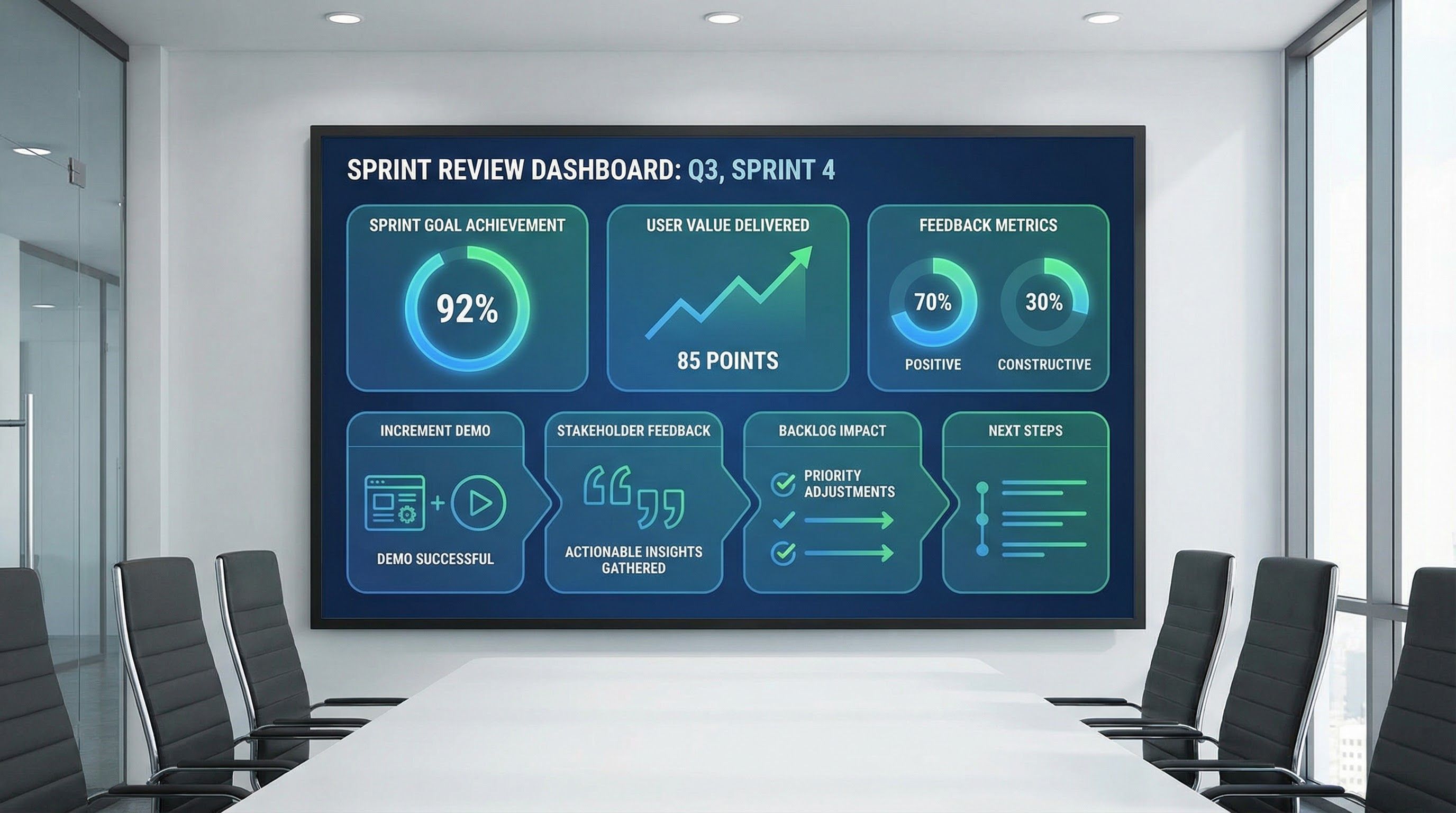
Sprint Dashboard - Performance Metrics Overview
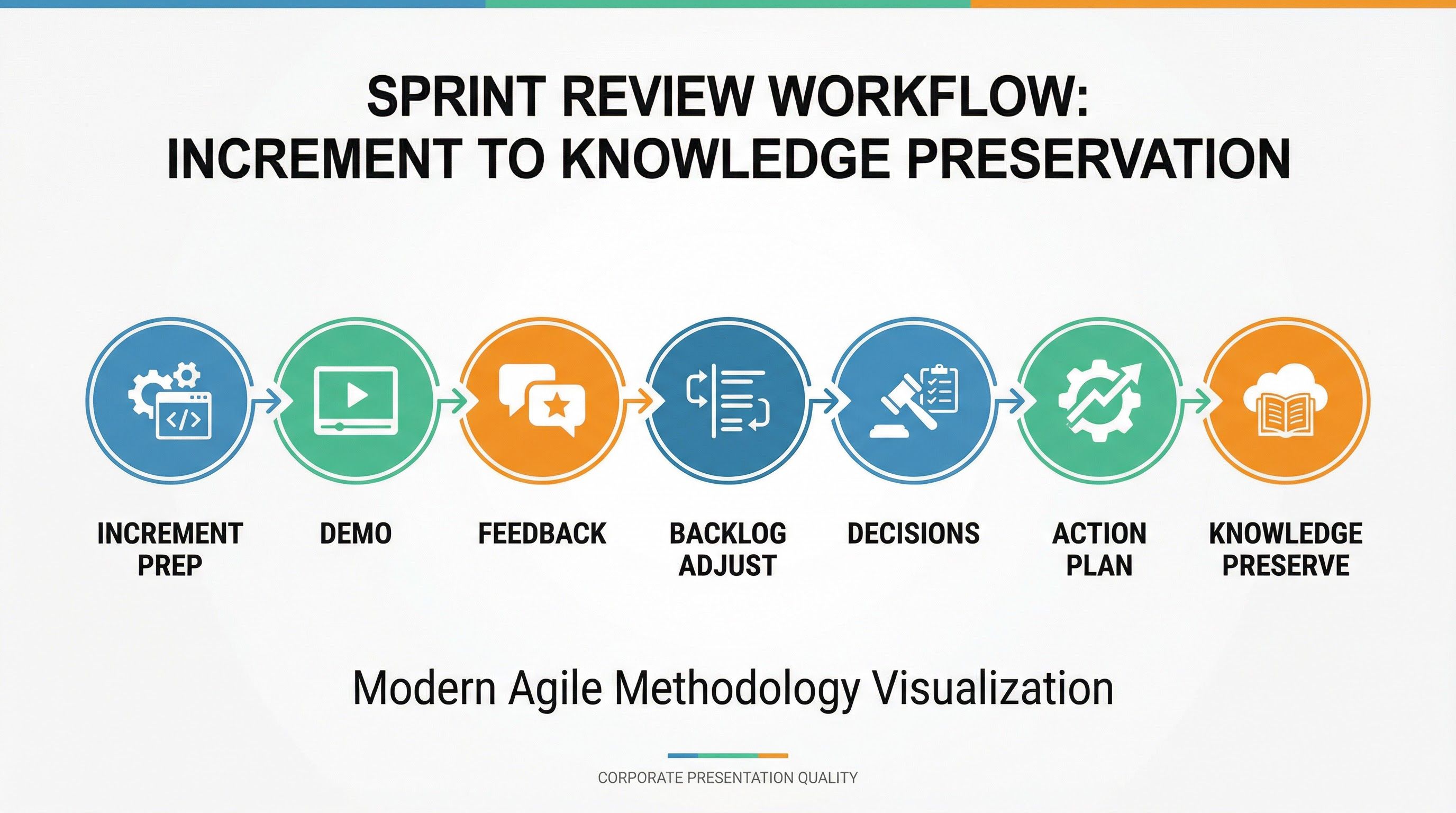
Sprint Review Process - 7-Step Framework
Beta Testing Metrics (500 Users, 2 Weeks):
- Onboarding completion: 94% (vs. 68% baseline)
- First workout within 24 hours: 85% (vs. 42% baseline)
- Weekly active users: 67% (vs. 42% baseline)
- Churn at 30 days: 22% (vs. 28% baseline)
- NPS score: 58 (vs. 32 baseline)
Market Context:
- Connected gym equipment market: $2.75B (2024) → $14.03B (2033)
- CAGR: 21.1%
- B2C segment: 76.74% of market
- Millennial/Gen X: Highest ownership demographics
- North America: 51.03% market share