Kuse vs n8n: Natural-Language Workflows vs Technical Automation
Compare Kuse vs n8n for workflow automation. See when to use technical node-based automation and when to use natural-language AI workflows for knowledge work.
Kuse vs n8n: Natural-Language Workflows vs Technical Automation
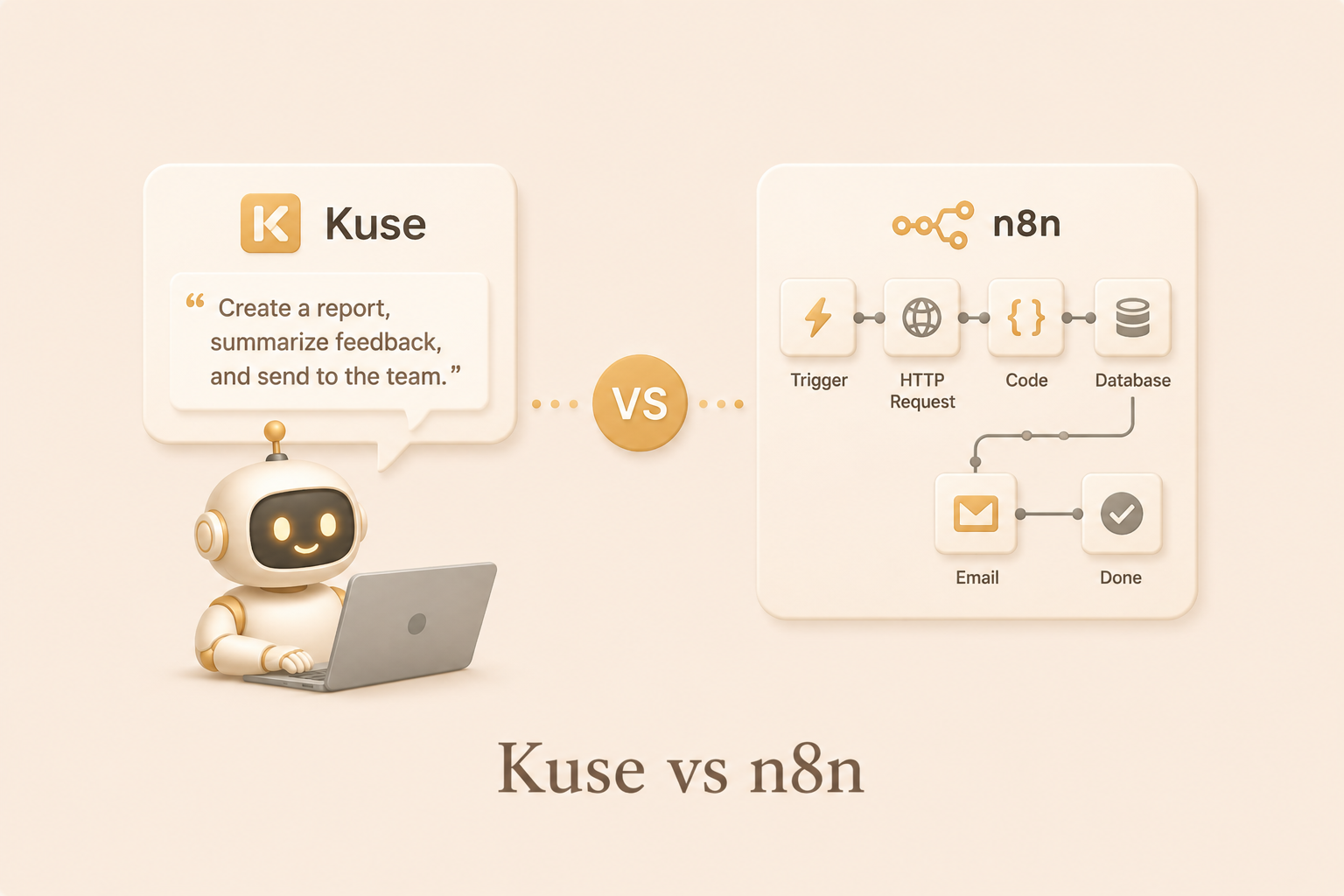
Kuse and n8n both help teams automate work, but they solve different problems. n8n is best for technical teams that want to connect apps with nodes, triggers, credentials, and API logic. Kuse is best for knowledge workers who want to describe a recurring work process in plain language and get a usable deliverable back.
Short answer
Choose n8n when you need precise technical automation across tools. Choose Kuse when the workflow includes research, writing, synthesis, reporting, or business judgment, and the owner of the work does not want to maintain a node graph.

At a glance
Use this comparison as a quick filter before you choose a workflow tool.
What n8n is built for
n8n is a powerful workflow automation platform for teams that think in systems, APIs, and precise logic. It works well when the process is already known: when this event happens, call this API, update that record, notify this channel, and store the result. For technical teams, that control is the value. You can compare this with the official n8n documentation.
What Kuse is built for
Kuse is built for recurring knowledge work where the hard part is not only moving data. The hard part is understanding context, reading files, making judgment calls, and producing something a person can use. A Kuse workflow can create a research brief, weekly report, content plan, spreadsheet, or presentation from plain-language instructions and saved context.
This is the same shift explained in AI Workflow vs Traditional Automation: the workflow is not only a chain of actions. It is a system that can produce real work.

Key differences
1. Natural language vs node configuration
n8n asks you to model the process as nodes. Kuse asks you to explain the desired outcome the way you would brief a coworker.
2. Outcome-first vs action-first
n8n is excellent for moving data and triggering actions. Kuse is stronger when the goal is a finished artifact, such as a report, lead brief, campaign plan, or review-ready document.
3. Context and memory
Technical automation usually passes context between steps. Kuse keeps files, prior outputs, preferences, and examples in the workspace so the next run can start with more context.
4. Maintenance
When an n8n workflow changes, someone edits the graph. When a Kuse workflow changes, the owner can describe the new requirement in plain language.
Real examples
Sales research
In n8n, a workflow might enrich a lead record and send a Slack alert. In Kuse, the same goal can become a weekly lead research brief with company context, recent news, objections, and email drafts.
Marketing content operations
In n8n, you can move a form response into a spreadsheet. In Kuse, you can turn a campaign brief and past assets into a content plan, first draft, repurposed posts, and a review-ready document.
Operations reporting
In n8n, you can sync task updates. In Kuse, you can summarize blockers, draft a status report, create a presentation page, and keep weekly outputs organized.
Which one should you choose?
Choose n8n if:
You need deterministic app-to-app automation.
Your team has technical owners who can maintain workflows.
The process depends on exact API calls, credentials, and branching logic.
Choose Kuse if:
The workflow owner is a knowledge worker.
The output is a document, report, spreadsheet, brief, page, or presentation.
The task needs files, context, previous outputs, or judgment.
You want to describe the result instead of building a technical workflow graph.

How to move from technical automation to AI workflows
1. Start with the deliverable the human actually needs.
2. Separate deterministic API steps from judgment-heavy steps.
3. Save examples, files, and prior outputs as workflow context.
4. Replace brittle step-by-step logic with clear output constraints.
5. Review the first few runs, then schedule the workflow once the output is stable.
Start building workflows in plain language
If your team already has automation engineers, n8n can remain a strong technical layer. If the bottleneck is getting recurring knowledge work done by non-technical teams, Kuse is the more natural starting point.
FAQ
Is Kuse an n8n alternative?
Kuse can be an alternative when teams use n8n mainly for research, reporting, content operations, or recurring knowledge work. It is not a one-to-one replacement for every technical API workflow.
Is n8n better for developers?
Usually yes. n8n gives technical users direct control over nodes, credentials, APIs, and branching logic.
Is Kuse better for non-technical teams?
Yes. Kuse lets people describe the work they want done instead of building and maintaining a technical workflow graph.
Can Kuse and n8n work together?
Yes. A team can use n8n for deterministic app plumbing and Kuse for the knowledge-work layer: reading, synthesizing, writing, and producing final outputs.